
A skincare brand is one of the most exciting business opportunities today. The demand for beauty products is high all over the world. However, many entrepreneurs and distributors get stuck on one major problem: How do I actually make the product?
You might have a great brand name and a marketing plan, but you probably do not have a factory, a chemistry lab, or a supply chain team. This is where a private label cosmetics manufacturer plays a key role.
Private label manufacturing is the secret behind many of the world’s most successful beauty brands. It allows you to sell high-quality, safe, and effective products under your own brand name, without having to invent the formula from scratch.
In this guide, we will walk you through the entire manufacturing process, from the first phone call to the moment the products leave the factory. Understanding these steps will help you make better decisions and avoid costly mistakes.
What is Private Label Skincare?
Before we jump into the steps, let’s define the concept simply. Private label means a manufacturer (the factory) produces a skincare product using a formula they have already created and tested. You (the brand owner) buy this product, put your own label and logo on it, and sell it as your own.
It is different from “custom manufacturing” where you invent a new recipe. Private label is faster, cheaper, and safer because the formulas are already proven to work.
Here is the 11-step process of how it works.
Step 1: Finding the Right Manufacturing Partner
The most critical part of the process happens before a single drop of cream is mixed. You must find the right factory.
Not all manufacturers are the same. Some are small labs that make handmade batches, while others are massive industrial facilities capable of supplying global distributors. For a professional brand, you need a partner that offers industrial standards.
What to look for:
- Certifications: You should look for ISO 22716 and GMP (Good Manufacturing Practice) certificates. These documents prove that the factory follows strict hygiene and safety rules.
- Capacity: Can they handle your order if you grow? You need a partner that can start small but has the machinery to produce thousands of units as your business expands.
- Export Experience: If you plan to sell globally, the manufacturer must understand international export rules.
Step 2: Selecting Your Skincare Formula
Once you have a partner, you get to choose your product. Most professional manufacturers have a “library” or catalogue of products. These are formulas that their chemists have spent years perfecting.
You will look through categories such as:
- Cleansing: Face washes, toners, and makeup removers.
- Treatment: Anti-aging serums, Vitamin C oils, and acne solutions.
- Moisturizing: Day creams, night creams, and body lotions.
- Protection: Sunscreens and barrier creams.
This step saves you months of time. Instead of trying to invent a face cream and hoping it works, you select one that is already stable and effective.
Step 3: Customization and Fine-Tuning
Just because you are choosing a ready-made formula doesn’t mean your product has to be identical to everyone else’s. There is usually room for “tweaking.”
Manufacturers often allow you to customize specific parts of the product to fit your brand’s story.
Common adjustments include:
- Scent: You might want a luxury spa scent, or perhaps no scent at all for sensitive skin.
- Key Ingredients: You might ask to add a specific extract, like Aloe Vera or Tea Tree Oil, to highlight in your marketing.
- Texture: You might prefer a lighter gel for hot climates or a thicker cream for dry climates.
The manufacturer’s team will tell you what is possible. They ensure that your changes do not ruin the stability of the formula.
Step 4: Stability and Safety Testing
Safety is the number one priority in the cosmetics industry. Even if the base formula is pre-approved, any small change you make (like adding a new fragrance) requires testing.
Before the factory makes a large batch, they perform several technical tests:
- Stability Testing: They put the product in ovens and freezers to ensure it doesn’t separate, melt, or change color under different temperatures.
- Microbial Testing: This checks that the preservatives are working and that bacteria or mold cannot grow in the jar.
- Packaging Compatibility: They check to make sure the cream doesn’t react with the plastic or glass of your chosen bottle.
This step guarantees that when a customer buys your product two years from now, it is still fresh and safe to use.
Step 5: Packaging Selection
Packaging does two jobs: it protects the product, and it sells the product. In private label manufacturing, you often get to choose from a selection of standard packaging options, or you can source your own.
Factors to consider:
- Material: Glass feels premium but is heavy to ship. Plastic is lighter and durable but needs to be high quality.
- Dispensing: Do you want a pump, a dropper, a jar, or a tube? A Vitamin C serum, for example, usually needs a dark bottle with a dropper to protect it from light.
- Sustainability: More brands are asking for recycled materials or refillable jars to appeal to eco-friendly customers.
Your manufacturer can advise you on which packaging is best for the viscosity (thickness) of your product.
Step 6: Labeling and Regulatory Compliance
This is the step where many new brands make mistakes. Every country has strict laws about what must be written on a skincare label. You cannot just write “Magic Cream” and sell it.
The label must list:
- The full ingredient list (using INCI standard names).
- The volume or weight.
- The “Period After Opening” (PAO) symbol.
- The responsible person or company address.
- Warnings (e.g., “Avoid contact with eyes”).
A professional manufacturer helps you with this. They provide the correct ingredient lists and ensure your label design meets the legal requirements for your target market, whether that is the EU, USA, or Asia.
Step 7: Sample Approval (The “Golden Sample”)
Before the big machines start running, the manufacturer sends you a final pre-production sample. This is often called the “Golden Sample.”
You must check this sample very carefully. You need to confirm:
- Is the texture exactly right?
- Is the smell correct?
- Does the pump work smoothly?
- Is the label printed clearly and straight?
Once you sign off on this sample, the factory uses it as the standard. Everything they produce afterwards must match this sample exactly.
Step 8: Bulk Production
Now the real work begins. The factory schedules your production run.
First, the raw materials are weighed. In a GMP-certified factory, this is done with extreme precision. If the recipe calls for 0.5% Vitamin E, the machine ensures it is exactly 0.5%.
The ingredients are then moved to large stainless steel mixing tanks. These tanks can hold hundreds or thousands of liters. They heat, cool, and mix the ingredients at specific speeds. This process ensures that the active ingredients are spread evenly throughout the entire batch.
Cleanliness during this stage is vital. The staff wears protective gear, and the air quality is monitored to prevent any contamination.
Step 9: Filling and Packaging
Once the bulk liquid (the cream, lotion, or serum) is mixed and approved, it needs to get into the bottles. This is called the “filling phase.”
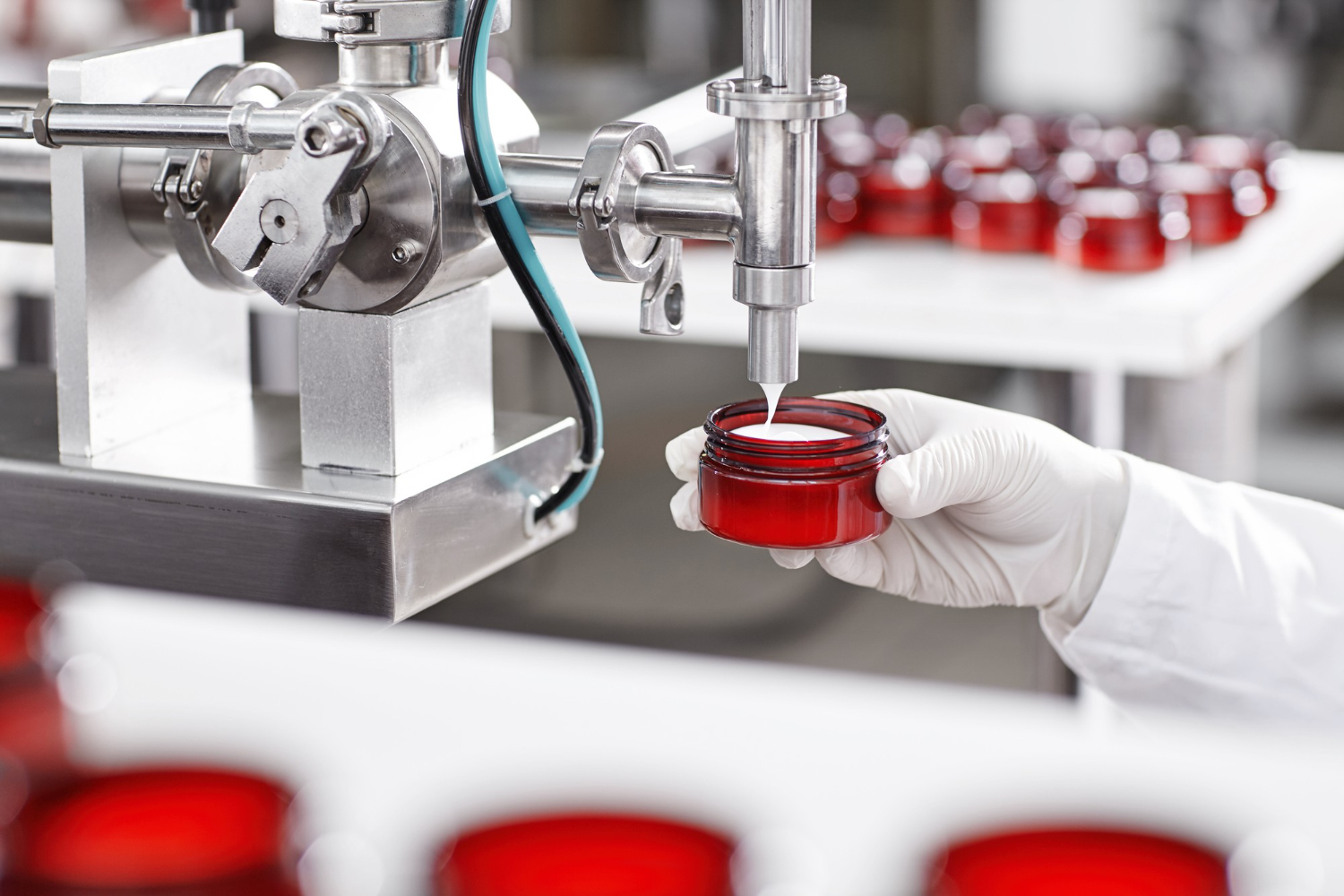
In a professional manufacturing facility, this is done using automated filling lines. Here is what happens:
- Cleaning: The bottles and jars are cleaned using air or vacuum systems to remove any dust.
- Filling: The machine fills the container with the exact amount of product. If the label says 50ml, the machine ensures it is exactly 50ml.
- Capping: The caps or pumps are applied and tightened to a specific torque setting. If it is too loose, it leaks; if it is too tight, the customer cannot open it.
- Coding: This is very important. Every bottle is printed with a Batch Number and an Expiry Date. This allows the manufacturer to trace the product history if there is ever a problem.
Step 10: Final Quality Control (QC)
You might think the job is done after filling, but a good manufacturer checks everything one last time. This is the “Finished Goods Inspection.”
The Quality Control team randomly selects boxes from the production line to check:
- Visual Appearance: Is the label straight? Is the box clean?
- Seal Integrity: Does the bottle leak if it is turned upside down or squeezed?
- Weight Check: They confirm once more that the weight is correct.
If even a small percentage of products fail these checks, the whole batch might be stopped and re-inspected. This strict process ensures that when your customer opens their package, they see a perfect product.
Step 11: Storage and Logistics
The final step is getting the product ready for the world. The finished products are packed into “master cartons” (large shipping boxes).
If the products are being exported to another country, the manufacturer prepares them for the journey:
- Palletizing: Boxes are stacked neatly on pallets and wrapped in plastic shrink-wrap to prevent movement during shipping.
- Documentation: The logistics team prepares the Commercial Invoice, Packing List, and Certificate of Analysis. These documents are required by customs officers to let the goods enter your country.
A manufacturer with export experience knows how to pack goods so they survive hot shipping containers and long truck rides without damage.
Why Choose Private Label? The Strategic Advantage
Now that you understand the process, you might wonder why so many global brands choose this route instead of building their own factory. The answer comes down to three things: Speed, Cost, and Focus.
- Faster Time to Market
Building a factory and developing a formula from scratch can take years. Private label allows you to launch in a few months. In the beauty industry, trends change quickly. Speed is money. - Reduced Financial Risk
You do not need to buy expensive mixing tanks or hire a team of chemists. Your capital can be used for marketing, influencers, and sales strategies—the things that actually grow your brand. - Reliability
When you use a private label formula, you are using a product that has already been tested and sold successfully. You are not a “guinea pig.” You have the peace of mind that the product is safe and effective.
Final Thoughts
The journey from a simple idea to a finished skincare product involves many technical steps. From the chemistry of the formula to the legal requirements of the label, it is a complex process.
However, you do not need to be an expert in all these steps. You just need the right partner.
By understanding the private label manufacturing process, you can see that the manufacturer acts as your technical team. They handle the science, the safety, and the production, allowing you to focus on what you do best: building your brand and connecting with your customers.
Whether you are a startup looking for your first product or a distributor expanding your catalogue, following this proven process is the safest and most efficient path to success in the global beauty market.